Search Glorious Little Soldiers

Monday, 31 July 2023

After an Almost Four Year Gap .....

 Yes Gentle readers , after almost four years in their boxes the 15mm Moderns collections gets a short run out.

British Challenger tanks with added stowage. 15mm Old Glory models. Painted by me.


 The Tantobie Warfare and Tactical Society met last Saturday in our newish venue for the July game.

 Andrew the Tekkie was in the chair and decided on a Moderns game using my 15mm Brits and 'Harrquis'- which are not at all for the Gulf Wars (!) Rules were a new set to us- Cold War Commander-  second Edition.

 To be honest I was a bit sceptical as Cold War Commander had filled me with ire and tedium when we tried it and I suspected the same here. But no there were much better. A full game report will appear in due course on Andrew's Blog Tantobie Internet Tattle so suffice it to say that I rather liked these- a bit dice heavy and slow until you get  to know them- the IGOUGO system slows things down as always- but they do have something so they are not to be consigned straight to the bin like the first edition.

 I can defintely see these being used again.

Warrior IFV's some with WRAP extra armour infantry behind- in game terms actuall in the vehicles of course.  Old Glory Models again painted by me. 


Pictures are all from my own collection. Most of the models both Vehicles and infantry are from the Old Glory Command Decision Moderns range.


The only game shot I took. British recon bugs out as the enemy appear while the Challengers move up to engage. T-72s and BMP s Again all Old Glory Models in 15mm  from my own collection.


Tuesday, 11 July 2023

'Old School' , 'Retro' and 'Modern' .

 So which is which and why?- and do we really care?

 First question. Is there really any difference between the three.?

 Honestly no not really, but well, yes sort of possibly.

 First, speaking personally, I simply prefer the term 'retro'  for a certain style of wargaming to the term 'old school' because for me 'old school' has certain connotations. First I hated the bloody place and was glad when - many years later- I found out that some bright fella had run a bull dozer through it immediately making that part of Greater Manchester a better place. Secondly because a chap once told me that 'old school'  wargaming remined him too much of cardigans, Ralgex and Werthers originals. I won't say he was wrong. 

 Definitely both 'old school' and 'retro'. ECW guns one part of Peter Gilders collection. They were called 25mm when they were made


So, for me the two terms 'old school' and 'retro' wargaming are rather similar though it depends - as always- on your individual view.

 Now I began wargaming at the aforementioned Grammar School in 1970 which was a while back and definitely 'old school' by today's standards. Armies were mostly Airfix with a few very precious Les Higgins, then a little later Hinchliffe. Rules were Featherstone or Wise, then London Wargames section Napoleonics. or awful home written concoctions. I recall writing rules  for the Indian Mutiny. They must have been awful since we had bugger all knowledge about how mid 19th century battles were conducted and not much more knowledge about how the armies were organised. or looked.(So a bit like some modern 'game designers' then!) 

Modern Old Glory 28mm Napoleonic painted by James Main for a client who wanted them in a 'retro' style. 


 By 1974 or thereabouts I had joined the Manchester  Area Wargames Society whose members were actually adults and owned wholly metal armies. Rules were still often homegrown but WRG had made its appearance and compared to the school club stuff was complicated but there were more periods- I saw my first ECW game at one of the meetings. 

 Once I moved up to the North-East, despite a brief dalliance with the rules published by Derek Sharman- which used a 'spinner'  rather than dice for the 'random factor' then for the next few years it was mostly WRG all the way Ancients and Pike and Shot. 

 Old Glory 28mm AWI 'Modern' style? 


All of this is in many eyes 'old school' - but when you try to find out what MAKES it 'old school'  the answers all  differ depending upon the age of and time in the hobby of, the person being asked. Often 'old school' seems to mean' what happened before I joined in'  or 'different from what I do now '  or even 'not as much fun cos you had to know stuff '. 'old school 'perhaps but it is 'retro' ?

Indian Mutiny - mutineers Old Glory 28mm organised for Young and Lawford's 'Charge - or How to play Wargames' a 1960s rule set which I still find useful for smaller battles. 


For myself I tend to use the term 'retro' more for the look of the table and the  figure collection than for any other reason. Yes rules come into it somewhat but I can set up a retro looking game and use 'modern' rules- though I'm not sure why I would do this as many 'modern' rules are overly wordy- sometimes close to 'barkerese' that I can't be bothered to  spend the time puzzling them out or sorting out the useful bits in the overly pretty eye candy filled book. No always true but of modern style rules I have bought in the last 3 or 4 years only 'In Deo Veritas'  for large Pike and Shot battles in smaller scales  has made sense in less than  4 or 5 readings- but I don't really want to go into 10mm- though I will keep bending Jim's ear in that direction ! (He already has a bundle of 10mm SYW) 

Some of my deliberately 'retro' 30mm collection with  some of the plastic trees.


Mind you I HATE reading rules. The often arcane language is very off putting 'roll 97 22 sided dice in  alternate non -sequence while standing on one leg with a haddock in the left hand - then mark down one or possibly 2 casualty points but no more, then roll the 18 sided dice 13 times to decide your first unit's movement'  - yes I exaggerate rather more than somewhat-  but many modern rules do seem very dice heavy, seemingly replacing thought and decision making by dice rolling. If I wanted to plat a dice based game I'd play snakes and ladders. 

Ok , after that digression, back to the plot. The easiest way to spot what might be a retro game is the look- gloss varnish on the models is a good start and then possibly the make of models-  Minifigs possibly or Garrison or Hinchliffe or  Stadden or Hinton Hunt or Les Higgins or Lamming  or possibly even more obscure makes such as Corvus or  Vulcan.  

It is also not difficult to mix the styles. My Indian Mutiny collection  are all modern figures painted in a 'modern' style with matt varnishing are singly based and will be used for a 'Charge! variant- said rules by Young and Lawford being definitely 'old schll'  since they were published for the first time in the late 1960s but I can also use them for such modern sets as 'The Men Who would be Kings'  assuming I can get those rules to fit the Mutiny without destroying any period feel.

Does the owner of said, old lead dudes refer to them as 25mm rather than the  'cool' 28mm which is so old it dates from as long ago as the the mid 1990s. For the record two of my own retro projects are in 30mm - just to confuse the issue..

 I've also been told that 'old school' rules are more complicated 'all those tables and stuff' or indeed that they are very simple- by which they usually mean over simple really, once again old school seems to mean 'what I don't want' or even 'what I like' depending upon who you speak to.

 One thing might be close to a constant 'old school' types are often more likely to question the rules and bin them if their own knowledge tells them said rules are garbage. On that score I am definitely 'old school' . Slavish obedience to 'da rools '  at the expense of the history is for fantasy dudes and games slaves, not open minds. Mind you there was a lot of that kind of stuff back in the day so maybe that is old school too! 

Now my collection of plastic trees are definitely old school- they take pride of place in my retro games and sometimes turn up in the 'modern' style too. For a start they don't scatter flock everywhere like the bog brush trees you often see. But I'm glad I bought most of them in the 1970s as they tend to work out at around 20 quid each for the larger specimens on ebay these days. 

It also seems that in ye olden days- depending on how far back that actually is- units were often larger- see Grants 5 officers and 48 man infantry units wheras today a 24 figure unit is not infrequently touted as 'standard'  but then so is '4 bases'  in rules where the models are often no more than counter decoration- but then even that is in some eyes 'old school' - Phil Barker opined almost exactly that is several of his rule sets back in the 1970s.

 So my point really is- beyond the look of the thing- is there really any such thing as 'old school' or is it really merely 'doing it my way' rather than merely being a consumer of the latest gaming fad. 

For myself I will always prefer 'historical period' to 'gaming fad'.

 So even the way I buy into any new (for me) period might be 'old school'  it usually goes ' That's interesting'- himm what models are available- how do I want to present them on the table?-  ok what rules can I use?- Which ones are any good, and will I lose the will to live trying to read the bloody things (reading rules can kill my interest in a period faster than any other single thing). Rule are always at the bottom of the thought chain I have often bought and even painted the armies before I have thought about rules.

I suppose that  makes me old school' then ... or does it?


Friday, 30 June 2023

Catching Up On My Reading 17.

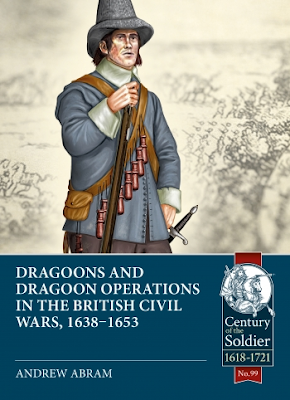
 Dragoons and Dragoon Operations in the British Civil Wars  1638-1653. by Andrew Abram.

 Helion- Century of the Soldier series no 99.. Softback 334pp.


It has bee a while since I have done a book review on this blog- mostly because I have been writing rather than reading but I picked this one up at the Partizan show in May and have finally got around to reading it.

Another big chunk of a tome from Mr Abram  and a pretty dammed good chunk it is.

 There are twelve chapters which take the reader through all they might need to know about dragoons during the Civil Wars. in England and Wales- Scotland being only mentioned insofar as Scottish troops in England are concerned. These mounted infantry were a vital tool in fighting the campaigns of the mid- Seventeenth century.

There is plenty of detail here.  Arms, dress, horse management, and unit organisation are all covered in detail as are methods and operations. Anyone with more than a passing interest in the Civil Wars will need this adding to his library.

 As with his previous books I found Mr Abram's research impressive down to the officer and sometimes lower ranks of individual dragoon companies. 

 This book will repay careful study.

Niggles- well yes . Illustrations are on the thin side, and some of them seem a bit incidental such as the covers  of pamphlets that are-very usefully- quoted from. There are no maps nor any colour plates other than the cover. This one is for military historians rather than wargamers, but that is as it should be and these niggles do not really detract from an otherwise excellent book. 

Recommended. 


Monday, 26 June 2023

Finished- well more or less.

 OK That is the Sikh wars book finished more or less- Text completed anyway along with the maps and some of the illustrations.


25BNI. A Foundry unit painted by my Co-Author James Main. 

This should be out before Christmas this year or so I'm told. I do still have a bundle of photos to take though I have about a dozen or more already in the bag. Still more to do though.

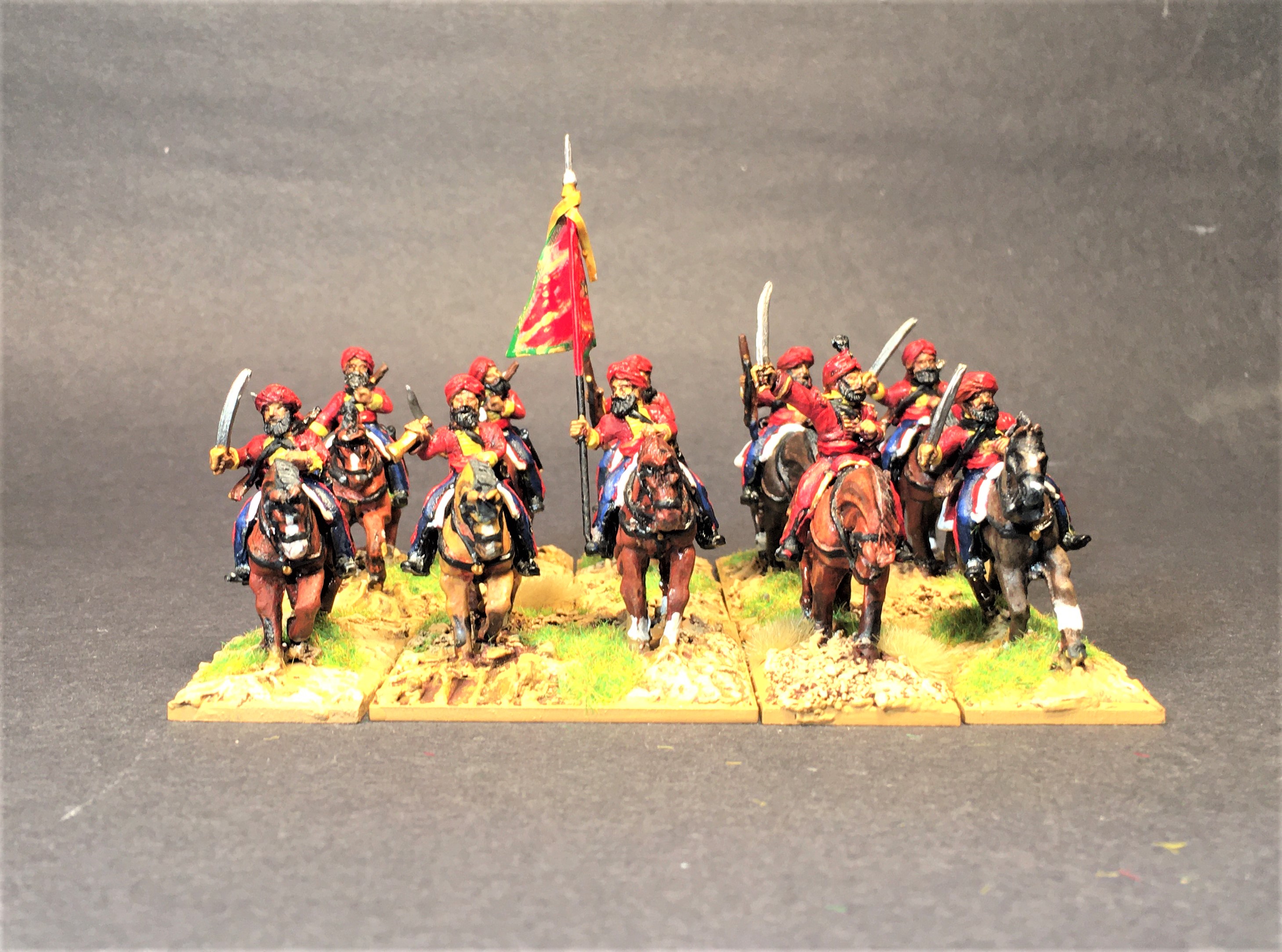
Sikh Regular dragoons Old Glory models painted by me. 


 Those in this short not will not be amongst those in the book.


Sikh High command . Old Glory figures painted by me. 

Right off to the photo 'studio' .

Tuesday, 6 June 2023

The Second Battle of Fiddlers Rise June 1459

Early in the day. The Yorkist assault force.

 So once again the  Tantobie Warfare And Tactical Society meet in their new(ish) venue for a game. We had a total of five members this month and I was in the chair so decided upon a 40mm Wars of the Roses game. Shaun and new member Paul taking the Yorkists with Andrew and Steve taking up the sword for the House of Lancaster.

Early in the day. The Lancastrians occupy their palisade in the centre
Their right is on the hill of Fiddlers Rise.


Forces are currently quite small with  less than 200 models on the table for both sides . Rules are Tony Clipsom's set 'Foray' as our guide and your gentle author as Umpire..

 The scenario was based very loosely on the Battle of Blore heath- but without the mass of Lancastrian cavalry. Indeed the roles were reversed as the Lancastrians were on the defensive and the Yorkists had more troops so the attack was in their hands.

As it happened the fighting developed into a bit of a grinding match with neither side using anything resembling subtly, but then this was 1459.

The Yorkist cavalry advance.


 The game began with some mutual cannonading , each side hoping the others bombard would explode in an inconvenient manner which this time neither sides actually did though the crews suffered soem casualties and  one Lancastrian crew fled the scene early in the day.

The Yorkists decided on a full frontal attack using their Longbowmen to 'shoot them in' In the event this was less than successful as the Lancastrian defenders had more archers and used them- though with mixed results.  On the Lancastrian right the Yorkist assault was led by a contingent of Warwick's troops under Sir John Conyers. These chaps did not have a good day. After a bout of archery the ragged staff fell and Conyers was killed. The unit did not rout but halted and while not willing to run played little further part in the action other than archery, their attempt to close with the enemy resulting in a half hearted melee which  neither side actually won before a mutual breaking off..  This flank also saw the only cavalry action of the engagement. The small band of Yorkist horse charging the tiny contingent of the Earl of Exeter( not painted many of these yet)  Although Exeter's men were routed the Yorkist banner fell and rather than pursue the routers they fell back to 'consider their position'  and again took no further part in the action. 

Arrows fly.


In the centre the bulk of the Lancastrian archers stood behind their palisade and shot it out with the Yorkists not infrequently to little avail on either side though the Lancastrian artillery was silenced early on by a combination of Yorkist archers and their 'comedy bombard- which was not funny at all in this game.

The Yorkist advance grinds to a halt. 


With their momentum exhausted the Lancastrians did not look able to storm the Yorkist position but then neither did the House of York look capable of doing any more than staying put. Both sides had suffered significant losses with the worst  being on the side of Lancaster so this one was declared a bloody draw.

I as umpire need to tweak the rules a little- making 'counter battery' fire impossible- not merely inadvisable and tightening up some morale situations and command rules. Though most of this is simply organisation. I shall return to the 15th century later in the year . The Hoses of York and Lancaster will battle it out once more across the table.

 Thanks to Norman Oyston for the use of the venure and to Ros for the excellent hot beef - or indeed Pork sandwiches to sustain the innner wargamer ! 

Saturday, 27 May 2023

Footprints

 How many times over the years have you rebased your collection - or at least parts of it. It is a right faff for sure, so I try to avoid it where I can. As I don't do competitions this is usually not a problem.

However in recent months I have come to wonder about the way certain rules and 'games' now portray the units for their given period and how the 20mm frontage for most infantry and 25mm for many cavalry has evolved, and is it the best way?.

What started this train of thought was looking at some assorted 28mm Napoleonic models of various nations all on 20mm frontage bases and also quite a few of the often called 'standard' unit(of which in reality there was no such thing) . Seen as units the troops looked too spread out with lots of daylight between each man. Don't think it was like that. Look at the modern Trooping of the Colour or even a decent re-enactment unit. They move about with very little space between each man most of the time.

Now this does not apply in certain periods of course. 17th century chaps needing more room to perform their drills- and it was not because of the baggy  breeches ! . No they mostly moved about  with some little distance between each man so my ECW dudes (or is than now W3K dudes) can stay as they are.

 No this is really about my 18th century collections 7YW and AWI really but with some Indian stuff  as well and maybe some Marlburians.

My first Marlburian unit. The rank and file are on 15mm frontage the 'Command' figures are on 20mm frontage. My reasoning here being that they should be bigger targets in the Grantian style games these will hopefully one day be used in.


 Now I have heard the argument that the larger figures won't fit on  smaller frontage bases so I thought I'd try a few experiments and - so fat I have not found any major problem with infantry. though I am keeping the depth at 20mm per model, as the depth of the figure won't allow much reduction.

Reducing the frontage per figure from 20mm to 15mm obviously reduces the frontage of the whole unit by a quarter as well as making the unit look- dare I say- a little more 'realistic' in its tabletop appearance.

This awful picture nevertheless shows the difference in frontage on even these two tiny units
 actually 2 grenadier companies from different AWI units. Both groups are from the same pack of models Old Glory AWI21. The upper group's frontage is 60mm the lower 45mm.

Another shot showing the two differing frontages side by side. I definitely prefer the closer look..


Now I won't be changing all of my troops. This will only be  chosen units for certain types of game. My 30mm Stadden and Willie AWI collection will stay on 20mm frontage(and shiny!) Shinyloo will stay as it is, as will the nascent 'Shinynine'... but if I ever get around to the Peninsular well that - and India will be a different story.


Friday, 5 May 2023

The Maze of Curiosity and Fascination.

 No not some 'new and innovative',  but the same as all the others in a different box,  Sci-Fant skirmish a like, but rather another train of thought. Yes I know I'm doing thinking again and it is not fashionable in today's wargaming world but then I don't give a hoot for fashion - wel not the wargaming kind anyway.

 No this is more about where my version of the hobby takes me and why. I know that these days- assuming you believe the magazines and some of the FB pages I see that the whole hobby is 'game driven' . We are no longer supposed to talk about which historical period we play in but only about 'which games' we play.

 To me this is terribly narrow. Obviously it is one of the unforeseen side effects of the commercialisation of the hobby. For many it is easier and more convenient to be merely consumers of what is laid before them especially in the hurry up world in which we now live. It is easier to simply take a game and obey the rules rather than take an interest in the historical period in which that game may be set- however loosely.- rather than follow the more tortuous path of historical interest.

What began this particular tortuous path was the arrival of a bundle of old  Journals  of the Society for Army Historical Research bought on ebay. This bundle of rather random copies  were originally published in various years from 1948- 1985 and will be added to the collection of back issues I already have. I made space for them by binning a bundle of old wargames mags- all published after 2000 but I may be binning some more in the near future as they simply often don't contain anything that really interests me any longer. I know how to roll a dice thanks- and reviews - while being useful at the time don't have much of a shelf life. 

These Journals however, are filled with  gold. In the issues I have recently bought, I have so far, found  first hand accounts - in letters and diaries published in the Journals, from the First and Second Sikh Wars, The Napoleonic wars,, the Nepal War and the Indian Mutiny. In addition there are articles on Mercenaries in English service in 1544- and how some of them defrauded Henry VIII of lots of cash, and I have not been through more than half of them so far.

Yes in some of the articles the scholarship is a bit- or even a lot- dated but taking that into account is part of the challenge. The words of chaps who were actually there, of course, never get old and provide information  and scenario ideas that  never get into most  wargames scenario books. This kind of stuff will always be of more interest to me than wading through yet another  set of games driven fluff in a pretty book written by a bloke who values dice rolling over period knowledge. 


Well now perhaps I should put on my metaphorical Tin Hat and duck below the parapet. If I do bin some more magazine I will let you know before they go to the shredder.